Luke Yoquinto and Katie Warren Present on Longevity at IAGG World Congress in Amsterdam
by Niels Wu

AgeLab researchers Luke Yoquinto and Katie Warren presented posters at the 23rd World Congress of Gerontology and Geriatrics hosted by the International Association of Gerontology and Geriatrics (IAGG), which took place in Amsterdam. The IAGG supports research across the globe aimed at promoting quality of life for all people as they age.
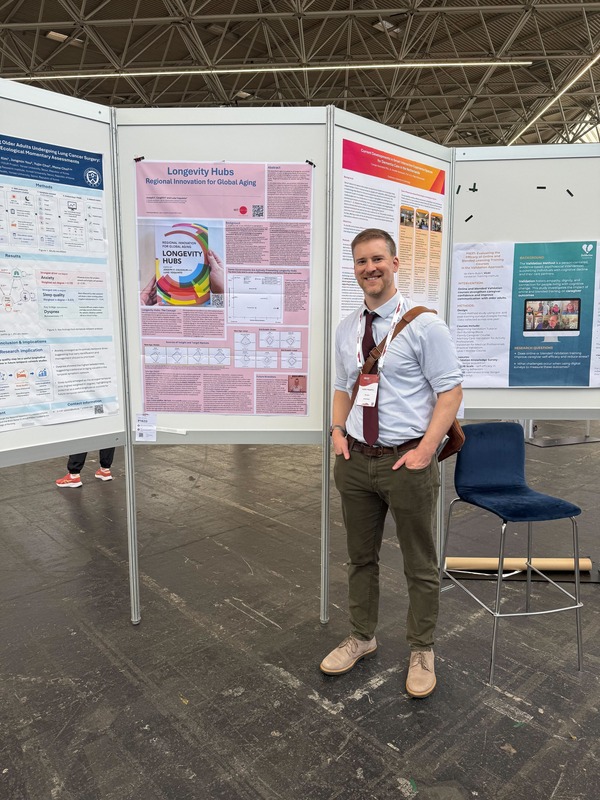
Yoquinto’s poster was titled “Longevity Hubs: Exploring Regional Innovation for Global Aging.” Leveraging research from Yoquinto’s book, Longevity Hubs, it examines ten sites with notably robust levels of innovation aimed at older people. These places include Louisville, São Paulo, Tel Aviv, and Newcastle.
Yoquinto’s poster drew on interviews and essays from experts from each “hub” as well as from Aging 2.0, an international network convening innovators and investors to develop technological healthcare solutions for aging populations. Findings show that regional economies innovate within both established markets like senior housing and healthcare, as well as newer markets such as those for emerging technologies.
Yoquinto also found that top-down decision structures like government directives tended to drive innovation in established markets, while grassroots efforts tended to be associated with new markets. This split indicates that there are different types of hotspots for longevity innovation.
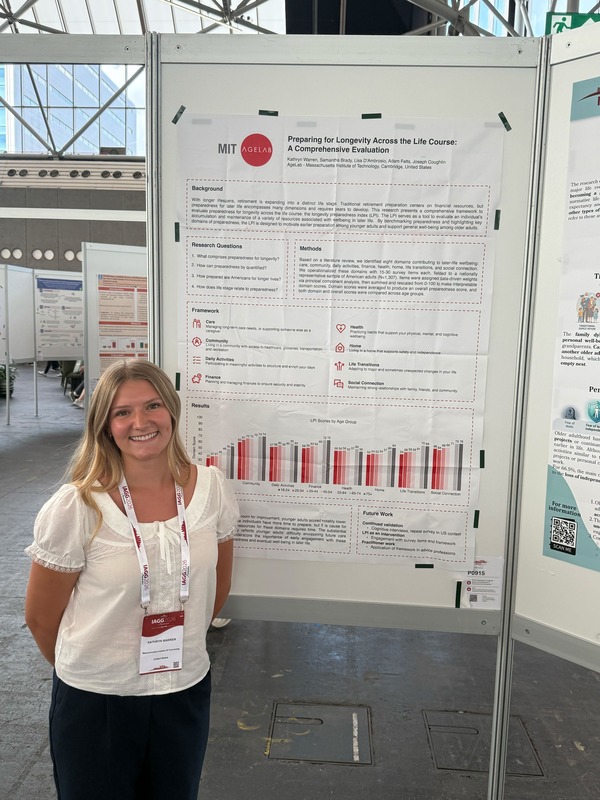
Warren’s poster, “Preparing for Longevity Across the Life Course: A Comprehensive Evaluation,” provided an overview of the Longevity Preparedness Index, a framework developed by the AgeLab to evaluate a person’s preparedness for older age across eight life domains, and provide a corresponding score between 0 and 100. The Index takes a holistic perspective on preparedness, examining factors such as the age-readiness of one’s home or the strength of their social connections.
Warren’s poster also analyzed survey data collected using the Index from a sample of American adults. On average, the sample scored 60 out of 100, showing considerable room for improvement.
Comparing both domain and overall scores across age groups, Warren found that people’s preparedness generally increased as they got older, particularly with regards to preparedness for providing or receiving care; people 75 years or older scored an average of 55 out of 100 compared to just 33 for people 18 to 24 years old.
Warren observed that the lower scores for younger adults is not necessarily cause for alarm, as they have more time ahead of them to prepare. However, preparation takes time and effort, meaning early awareness and action are important to ensure preparedness in later life.
The AgeLab is conducting ongoing research on how the Longevity Preparedness Index may help people assess and improve their own readiness for later life.
- Share